

Vancouver, BC – July 8th, 2026 – Lode Gold Resources Inc. (TSX-V: LOD; OTCQB: LODFF) (“Lode Gold” or the “Company”) is pleased to announce that further to its news release dated June 29, 2026, it has filed its independent National Instrument 43-101 (“NI 43-101”) Technical Report, “NI 43-101 Updated Technical Report for the Fremont Gold Property, Mariposa County, California, USA” for the Fremont Gold Mine on SEDAR+.
Mineral Resource Estimate and Sensitivity Analysis
The updated mineral resource estimate incorporates multiple cut-off grade scenarios evaluated within the block model to demonstrate the nature of the deposit under varying parameters. The official tonnage, average gold grades, and contained ounces are detailed independently by resource classification in the following tables:
Table 1: Mineral Resources Report per category at 0.82 g/t cut-off
| Category | Tonnage (Mt) | Au (gr/t) | Au Content (Moz) |
| Indicated | 19.9 | 1.79 | 1.15 |
| Inferred | 38.5 | 1.73 | 2.17 |
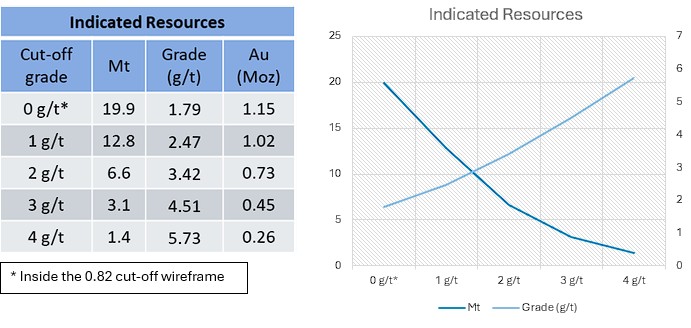
Table 2: Indicated Mineral Resource Sensitivity
Table 3: Inferred Mineral Resource Sensitivity
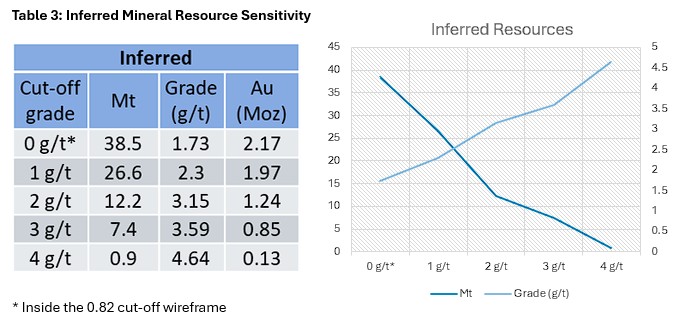
* Inside the 0.82 cut-off wireframe
Technical Commentary on Thickness and Mineralization Density
To complement the global resource framework, the Grams x Meter (g*m) is a very useful metric to evaluate the intensity of gold distribution (mineralization density) in the Fremont Gold Mine.
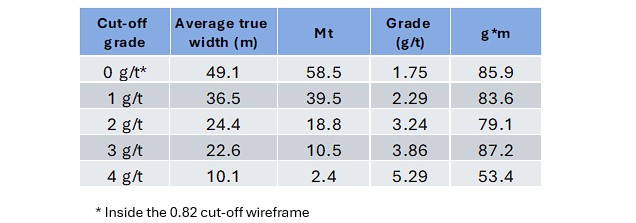
Table 4 shows the spatial and geometric behavior of the mineralized domains across sequential cut-off grade increments. By consolidating the physical parameters of thickness, tonnage, and grade, this analysis illustrates how the deposit scales uniformly:
Table 4: Combined Deposit Geometry and Metal Intensity Profile
* Inside the 0.82 cut-off wireframe
In the Fremont Gold mine, the global g*m values remain consistent across cut-off grade increments from 0 g/t up to 3 g/t Au. This stable relationship highlights key technical attributes of the deposit:
- Predictability: The grade increases in direct mathematical proportion to the reduction in mining width, maintaining a stable metal density of mineralization.
- Operational Optionality: The balanced distribution allows for the evaluation of a variety of engineering scenarios, ranging from bulk-tonnage configurations within the wider envelopes to selective underground designs focused on the internal vein structures.
- Structural Coherence: The continuity of the g*m values confirms that the higher-grade mineralized components are structurally hosted and well-defined within the overall domain geometry.
Commenting on the engineering implications, Jon Hill, Chair of Lode Gold’s Technical Committee and Director of the Board, stated:
“The grade consistency of our deposit provide operational optionality. Because of the unvarying gram x meter values, adjusting cut-off grades maximally affects the tonnage and the ounces of recoverable gold and minimally the grade. Because the mineralization is homogeneously distributed, any operational dilution will be with mineralized rocks, limiting impact in project economics.”
Grams per Meter Calculation: Width and Continuity Verification Methodology
To demonstrate the geometric continuity and robust nature of the mineralized body within the Reasonable Prospects for Eventual Economic Extraction (RPEEE) stope solids, a block-model-to-pseudo-drillhole analysis was conducted. This process evaluates the true geometric width of the mineralization across various cut-off grades to ensure that the reported widths are not artificially inflated by low-grade internal dilution or peripheral waste material.
The verification process was executed as follows:
- Step 1 (Spatial Filtering): The optimized stope solids defined by the RPEEE were intersected with the resource block model. Any blocks located outside of these economic solids were excluded from the dataset.
- Step 2 (Pseudo-Drillhole Generation): Each remaining block within the stope solids was converted into a pseudo-drillhole (or pseudo-borehole) oriented perpendicular to the strike/dip of the mineralized body to capture the true thickness.
- Step 3 (Width Aggregation): These pseudo-drillholes were composited and aggregated along the perpendicular vector to calculate the true geometric width of the structure.
- Step 4 (Sensitivity Analysis): This extraction process was repeated iteratively at progressive cut-off grades of 0 g/t, 1 g/t, 2 g/t, 3 g/t, and 4 g/t.
- Step 5 (Grade-Thickness Calculation): Finally, the average geometric width at each cut-off was multiplied by its corresponding average grade to determine the gram-meter (g*m) values.
Key Findings & Model Robustness
The analysis demonstrates that the mineralized structure maintains a remarkably consistent grams*meter ranging between 79 and 87 g*m across cut-off grades from 0 g/t up to 3 g/t. This stability confirms the absence of low-grade “halo” or internal waste material that typically inflates mineralized intercepts at lower cut-offs. The expected reduction to 50 grams*meters at a 4 g/t cut-off successfully defines the high-grade core of the deposit, further validating the geological consistency and predictability of the block model.”
Resource Sensitivity and RPEEE Parameters
The updated estimate establishes a base-case cut-off grade of 0.82 g/t Au, determined under current gold price parameters and baseline operational cost estimates to satisfy Reasonable Prospects for Eventual Economic Extraction (RPEEE) requirements.
The sensitivity analysis describes the internal distribution of the deposit through the following sequential trends:
- Tonnage and Thickness Reduction: Progressive increments in the cut-off grade result in a correlated, step-by-step reduction in total mineralized tonnage and widths.
- Grade Progression: Higher cut-off thresholds yield a corresponding, predictable increase in the average gold grade of the remaining blocks.
- Domain Integration: The 0.82 g/t Au base-case cut-off serves as the technical baseline that encompasses the full mineralized volume, successfully integrating the enveloping disseminated mineralization and the internal vein structures for potential economic extraction.
Wendy T. Chan, CEO and director of the board of Lode Gold, commented:
“As the price of gold has gone up, our base-case scenario for the resource has been updated. We have moved from 3 g/t cut-off in the 2025 MRE, to under 1 g/t cut-off with gold at current market price and mining cost levels. This is a positive advancement for the company, as it allows us to capture the full market value of the deposit and build a much larger, more robust project for our shareholders.”
About Lode Gold
Lode Gold has key assets in Canada and United States.
Fremont Gold Mine Project (Fremont Gold Mining LLC) is a brownfield project in Mariposa, California with 43,000 m drilled, 10,000 underground channel samples, 14 adits and 2 shafts. Mining halted in 1942 due to the gold mining prohibition during WW II. It was mined at 10.7 g/t when price was gold was $35 per oz. PEA was completed (link) in 2023. The PEA was based on 1.16 Moz at 1.90 g/t Au within 19.0 Mt Indicated, and 2.02 MOz at 2.22 g/t Au within 28 Mt Inferred with a composite cut-off[1]. MRE (link) was updated in 2026; 89% of the ounces were left unmined if we compare historical production with our current Indicated Resource. Average true widths at 1 g/t cut off is 53m. Project sits on > 3,000 acres of 100% owned private and patented land which is designated as OZ, Trump Administration Opportunity Zone (Special Tax Incentives).
Dingman Property is an orogenic deposit in Ontario, Canada with over 22,000 m drilled, with a 2013 PEA, MRE (link to report) : 376,000 oz at 0.94 g/t within 12.5 Mt measured and indicated and 47,000 oz at 0.71 g/t within 2.1 Mt Inferred.
Qualified Person
The technical information contained in this press release was reviewed and approved byGary Wong, P.Eng., Vice President of Exploration of Lode Gold, designated as a qualified person under National Instrument 43-101.
ON BEHALF OF THE COMPANY
Wendy T. Chan
CEO & Director
info@lode-gold.com
+1(604) 977-GOLD (4653)
Kevin Shum
Investor Relations
kevin@lode-gold.com
+1(604) 977-GOLD (4653)
Cautionary Statement Regarding Forward-Looking Information
[1] 0.25 g/t for oxide, 0.45 g/t for open pit mineralization and 1.45 g/t for underground mineralization
